Planning condition
9 November 2023
Abstract
This specification defines the contents and format of data which a relevant planning authority or other party may use to provide information about one or more Planning conditions.
Status of this specification
This is a draft specification, following the standards for planning data process [design-process]. The contents of this specification are currently under development, and liable to change based on feedback.
This document places no obligations on any party to provide data in conformance to this specification.
A future version of this specification may be formally published on GOV.UK, and cited as one of a number of official data standards for the provision of planning data under the Levelling-up and Regeneration Act 2023 [LURA] or other legislation.
This technical specification is accompanied by guidance, examples and other tools which provide feedback to organisations creating data to this specification.
Comments and feedback on this specification may be provided on the GitHub discussion or sent to digitalland@communities.gov.uk.
Conformance
As well as sections marked as non-normative, all authoring guidelines, diagrams, examples, and notes in this specification are non-normative. Everything else in this specification is normative.
The key words MAY, MUST, NOT, and SHOULD in this document are to be interpreted as described in [RFC2119] when, and only when, they appear in all capitals [RFC8174] as shown here.
Datasets and fields
This section is non-normative
An index of the datasets and fields defined by this specification.
| Field | Requirement | Datatype |
|---|---|---|
| reference | reference | |
| name | string | |
| description | string | |
| reason | string | |
| organisation | reference | |
| notes | text | |
| entry-date | datetime | |
| start-date | datetime | |
| end-date | datetime |
| Field | Requirement | Datatype |
|---|---|---|
| reference | reference | |
| planning-application | string | |
| planning-condition | string | |
| document-url | URL | |
| documentation-url | URL | |
| description | string | |
| organisation | reference | |
| notes | text | |
| entry-date | datetime | |
| start-date | datetime | |
| end-date | datetime |
Dataset relationships
This section is non-normative
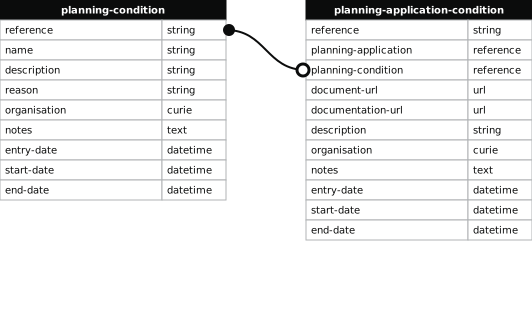
The following diagram illustrates the datasets specified by this document, and how data in a dataset entry may reference, or be referenced by an entry in another dataset.
Dataset details
Planning condition
The Planning condition dataset contains A condition that is attached to planning permission.
The Planning condition dataset contain at least one entry for each Planning condition for which the data provider is the responsible authority.
Reference
Each Planning condition entry MAY contain
a
reference field value.
The Planning condition reference field MUST be
a
reference value.
A reference for the planning condition.
Name
Each Planning condition entry MAY contain
a
name field value.
The Planning condition name field MUST be
a
string value.
A name used for this planning condition.
Description
Each Planning condition entry MAY contain
a
description field value.
The Planning condition description field MUST be
a
string value.
Text explaining the condition.
Reason
For providing a reason, for example, the reason a plannig condition has been set on an application.
Each Planning condition entry MAY contain
a
reason field value.
The Planning condition reason field MUST be
a
string value.
A text reason for the condition.
Organisation
Department, agency, body, company, group, or association of people.
Each Planning condition entry MAY contain
an
organisation field value.
The Planning condition organisation field MUST be
a
reference value.
The organisation that created the condition.
Notes
Notes and commentary about how this data was made or may be interpreted.
Each Planning condition entry MAY contain
a
notes field value.
The Planning condition notes field MUST be
a
text value.
Any additional notes about the condition.
Entry date
Entry date of the data.
Each Planning condition entry MAY contain
an
entry-date field value.
The Planning condition entry-date field MUST be
a
datetime value.
The date the condition record was created.
Start date
Date the entity became active or in force.
Each Planning condition entry MAY contain
a
start-date field value.
The Planning condition start-date field MUST be
a
datetime value.
The date the validity of the record starts.
End date
Date from which the entity is not longer active or in force.
Each Planning condition entry MAY contain
an
end-date field value.
The Planning condition end-date field MUST be
a
datetime value.
The date the validity of the record starts.
Planning application condition
The Planning application condition dataset contains A record of which conditions apply to which planning applications.
The Planning application condition dataset contain at least one entry for each Planning application condition for which the data provider is the responsible authority.
Reference
Each Planning application condition entry MAY contain
a
reference field value.
The Planning application condition reference field MUST be
a
reference value.
A reference for the planning application - condition connection.
Planning application
Each Planning application condition entry MAY contain
a
planning-application field value.
The Planning application condition planning-application field MUST be
a
string value.
A planning application reference.
Planning condition
A condition that gets set when planning permission is granted.
Each Planning application condition entry MAY contain
a
planning-condition field value.
The Planning application condition planning-condition field MUST be
a
string value.
A planning condition reference.
Document URL
A url to a document.
Each Planning application condition entry MAY contain
a
document-url field value.
The Planning application condition document-url field MUST be
a
URL value.
A url to the decision notice that includes details of the condition applying to the planning application.
Documentation URL
Each Planning application condition entry MAY contain
a
documentation-url field value.
The Planning application condition documentation-url field MUST be
a
URL value.
A url to a page where it is possible to find the decision notice.
Description
Each Planning application condition entry MAY contain
a
description field value.
The Planning application condition description field MUST be
a
string value.
A description of the condition applied to the application.
Organisation
Department, agency, body, company, group, or association of people.
Each Planning application condition entry MAY contain
an
organisation field value.
The Planning application condition organisation field MUST be
a
reference value.
The organisation that as added the condition to the planning application.
Notes
Notes and commentary about how this data was made or may be interpreted.
Each Planning application condition entry MAY contain
a
notes field value.
The Planning application condition notes field MUST be
a
text value.
Any additional notes about the planning application - condition connection.
Entry date
Entry date of the data.
Each Planning application condition entry MAY contain
an
entry-date field value.
The Planning application condition entry-date field MUST be
a
datetime value.
The date the record was created.
Start date
Date the entity became active or in force.
Each Planning application condition entry MAY contain
a
start-date field value.
The Planning application condition start-date field MUST be
a
datetime value.
The date the validity of the record starts.
End date
Date from which the entity is not longer active or in force.
Each Planning application condition entry MAY contain
an
end-date field value.
The Planning application condition end-date field MUST be
a
datetime value.
The date the validity of the record starts.
Source documentation
The source documentation is a web page where the user should go to confirm the validity of information provided in the data.
The source documentation SHOULD be a web page accessible as [HTML] from a public URL.
Finding the information on the organisation's official website helps users check the information in the data. It increases the trust the user may place in the origin of the data, and that it is more likely to be sustained.
The source documentation SHOULD be on the offical website for the organisation.
A Local Authority or other public body should put the documentation page under their .gov.uk domain.
The source documentation MAY either contain the endpoint documentation, or link to one or more separate endpoint documentation pages.
Endpoint documentation
The endpoint documentation is a web page where a user can find a link to where they can download the data (the endpoint), along with other information relevant to a data user, such as the date the data was last updated. Every endpoint needs to be findable via a link on the source documentation page, and the endpoint documentation can be on the source page, on a separate documentation point for each endpoint, or a combination thereof.
The documentation for an endpoint SHOULD be accessible as [HTML] from a public URL.
The endpoint documentation URL SHOULD have the same URL as the endpoint documentation page.
The endpoint documentation URL MAY have the same URL as the source documentation page.
The endpoint documentation include a hyperlink to one or more endpoints for planning condition data.
The endpoint documentation include a hyperlink to one or more endpoints for planning application condition data.
The endpoint documentation page SHOULD include a clear licence for reusing the data.
The data SHOULD be published as [crown-copyright] under [OGL3].
This data is © Crown copyright and available under the Open Government Licence v3.0.
The endpoint documentation page SHOULD include any further attribution a user of the data needs to provide if they copy, publish, distribute or otherwise retransmit the data.
Datatypes
Reference
The reference MAY be used to refer to the entity by other data.
A reference value MUST be either a [CURIE] or the reference part of a [CURIE] identifier.
A reference SHOULD be persistent. A reference SHOULD be used by the data provider to identify the same entity in the future.
A reference SHOULD NOT be used to refer to a different entity in the future.
Where a reference has been used to refer to two different entities, add a year or other text to disambiguate the references, for example use 'CA01' and 'CA01/2022' rather than just 'CA01' for two different conservation areas.
A reference SHOULD be short and meaningful to a user.
Datetime
Dates MUST conform to [ISO8601] following the [Open Standards for government guidance [formatting-dates-and-times-in-data].
A date value SHOULD be blank if it is unknown.
The date MAY just contain the year 'YYYY' if only the year is known, or 'YYYY-MM' if only the year and month is known.
Geometry
A geometry field MAY be eiher a single POLYGON or MULTIPOLYGON value.
When using Comma Separated Value (CSV), the geometry SHOULD be encoded as Well Known Text [WKT].
All points SHOULD be either in the [WGS84] (EPSG::4326) or [ETRS89] (EPSG::4258) coordinate reference system following the [Open Standards for government] guidance [exchange-of-location-point].
Boundaries provided by this dataset are intended to be used as an index. Positions calculated by the WGS84 and ETRS89 systems can currently deviate by half a metre for points within England. Survey data should be used where more precision is needed.
Coordinate values SHOULD be 6 or fewer decimal places.
Integer
A value in the integer values MUST conform to the integer datatype as defined by
[tabular-metadata].
Text
All text values SHOULD be compatible with [govspeak-markdown].
All text values MUST be encoded in UTF-8 [RFC3629]
following the [Open Standards for government] guidance [encoding-characters].
URL
All URL values MUST conform to [RFC3986].
For the purposes of this specification, the terms URL, URI and IRI are synonymous as set out in [URL-interoperability]
String
All string values MUST be encoded in UTF-8 [RFC3629]
following the [Open Standards for government] guidance [encoding-characters].
Historical data
Removing historical data can reduce the trust a user places in the quality of the data. There are also many uses for historical documents, data and material information in planning, such as when developing an older property, processing an appeal, and monitoring the delivery of housing on older brownfield land, and when collecting evidence for plan-making.
Entries SHOULD NOT be changed or removed from the data except to correct a mistake, or for the purposes of redacting personal or otherwise sensitive information.
An entity SHOULD be updated by adding another entry to the data with the same reference and a newer entry-date.
Entries SHOULD be ordered within a dataset by the entry-date value, with older entries appearing before later entries.
The end-date field SHOULD be used to indicate when an entity is no longer applicable.
Data file formats
Data MUST be provided in at least one of the following file formats:
- Comma Separated Value (CSV) [RFC4180]
- GeoJSON [RFC7946]
- OGC [GML]
- OGC [Geopackage]
- OGC Keyhole Markup Language [KML]
The preferred format for geospatial data is GeoJSON.
Tabular data SHOULD be provided as (CSV) [RFC4180] following the [Open Standards for government] guidance [tabular-data-standard].
Field names
The case and punctuation used in field names is insignificant, meaning
'StartDate',
'Start Date'
'START_DATE' and
'start.date',
are all valid ways of naming the 'start-date' field.
A field name SHOULD be treated as being case insensitive.
A non-alphanumeric character in a field name SHOULD be ignored.
Evolution
- Data may contain additional fields in the future. Processors must ignore any fields they aren't expecting.
- Fields in this specification will be deprecated in a future version, rather than being removed.
- Future versions of this specification MUST NOT significantly change the meaning of any of the fields in this version of the specification.
A sending processor conforming to this specification MAY include unspecified fields and values.
A receiving processor conforming to this specification MUST ignore any unspecified fields and their values.
Extensibility
The approach for evolution enables processors to extend the specification by including fields and data for their own purposes.
A processor SHOULD NOT add fields likely to be used in a future version of this specification for different purposes.
Endpoint
The endpoint is the URL for where data in a format defined by this specification may be downloaded. The Other patterns for collecting data are under consideration, including feeds for large datasets which change frequently.
Endpoints typically fall into 1 of the following 2 categories:
- a file hosted on your web server — these will usually be URLs which end in something like .json or .csv
- an API — these are usually hosted by your GIS (Geographic Information System) software or open data platform
Whenever your data changes, update it in the endpoint URL. Your endpoint URL should remain the same, do not change it when you make updates.
The endpoint MUST serve data conforming to this specification.
The endpoint MUST be accessible via HTTPS.
The data MUST be publicly accessible without authentication or authorisation.
Security and privacy considerations
There is a risk of people's names or other personally identifiable information appearing in the data, in particular notes, description and other text fields. It is the responsibility of the data provider to review and redact such information before publication.
The [OGL3] licence does not cover personal data in the Information.
The data MUST NOT contain any personal or sensitive information, unless explicitly required by this specification, or legislation.
Colophon
This document is © Crown Copyright and available under the Open Government Licence version 3 licence.
References
Normative references
- [RFC2119]
-
Key words for use in RFCs to Indicate Requirement Levels.
IETF Best Current Practice.
https://tools.ietf.org/html/rfc2119
- [RFC8174]
-
Ambiguity of Uppercase vs Lowercase in [RFC2119] Key Words.
IETF Best Current Practice.
https://datatracker.ietf.org/doc/html/rfc8174
- [RFC3629]
-
UTF-8, a transformation format of ISO 10646.
IETF Internet Standard.
https://datatracker.ietf.org/doc/html/rfc3629
- [RFC4180]
-
Common Format and MIME Type for Comma-Separated Values (CSV) Files.
IETF Informational.
https://datatracker.ietf.org/doc/html/rfc4180
- [RFC7946]
-
The GeoJSON Format.
Proposed Standard.
https://datatracker.ietf.org/doc/html/rfc7946
- [RFC3339]
-
Date and Time on the Internet: Timestamps.
IETF Proposed Standard.
https://datatracker.ietf.org/doc/html/rfc3339
- [RFC3986]
-
IETF Standard. Uniform Resource Identifier (URI): Generic Syntax.
https://datatracker.ietf.org/doc/html/rfc3986
- [URI-Fragment]
-
Section 3.5 of [RFC3986] Fragment Identifier of a URI
https://datatracker.ietf.org/doc/html/rfc3986#section-3.5
- [tabular-metadata]
-
Metadata Vocabulary for Tabular Data.
W3C Recommendation.
https://www.w3.org/TR/2015/REC-tabular-metadata-20151217/
- [tabular-data-model]
-
Model for Tabular Data and Metadata on the Web.
W3C Recommendation.
https://www.w3.org/TR/2015/REC-tabular-data-model-20151217
- [CURIE]
-
CURIE Syntax 1.0 A syntax for expressing Compact URIs.
W3C Working Group Note.
https://www.w3.org/TR/2010/NOTE-curie-20101216/
- [GML]
-
Geography Markup Language (GML).
Open Geospatial Consortium standard (ISO 19136-1:2020).
https://www.ogc.org/standards/gml
- [KML]
-
OGC KML 2.3.
Open Geospatial Consortium standard (12-007r2).
http://www.opengis.net/doc/IS/kml/2.3
- [Geopackage]
-
OGC Geopackage 1,4
Open Geospatial Consortium standard (12-128r19).
http://www.opengis.net/doc/IS/geopackage/1.4
- [WGS84]
-
National Imagery and Mapping Agency, "Department of Defense World Geodetic System 1984:
Its Definition and Relationships with Local Geodetic Systems", Third Edition, 1984.
The code for this standard in the European Petroleum Survey Group (EPSG) Registry is [EPSG::4326].
https://nsgreg.nga.mil/doc/view?i=4085
- [ETRS89]
-
The European Terrestrial Reference System 89 (ETRS89)
The code for this standard in the European Petroleum Survey Group (EPSG) Registry is [EPSG::4258].
http://etrs89.ensg.ign.fr/
- [WKT]
-
OGC Well-known text (WKT) as defined by ISO/IEC 13249-3:2016.
https://www.iso.org/standard/60343.html
- [ISO8601]
-
Data elements and interchange formats –
Information interchange –
Representation of dates and times", ISO 8601:1988(E),
International Organization for Standardization, June, 1988.
- [OGL3]
-
Open Government Licence for public sector information.
Version 3.
https://www.nationalarchives.gov.uk/doc/open-government-licence/version/3/
- [crown-copyright]
-
Crown copyright.
Section 163 of the Copyright, Designs and Patents Act 1988 as works made by officers or servants of the Crown in the course of their duties.
https://www.nationalarchives.gov.uk/information-management/re-using-public-sector-information/uk-government-licensing-framework/crown-copyright/
Informative references
- [LURA]
-
Levelling-up and Regeneration Act. Originated in the House of Commons, Session 2022-23.
https://www.legislation.gov.uk/ukpga/2023/55/enacted
- [process]
-
Ministry for Housing, Communities & Local Government planning data standards design process (service under development).
https://design.planning.data.gov.uk
- [GSS]
-
Office for National Statistics, Geography Coding and Naming Policy for Official Statistics Version 2.0, July 2025
https://geoportal.statistics.gov.uk/documents/5a050dcaac8049dc9dc0aa7de0943378/about
- [govspeak-markdown]
-
How to publish on GOV.UK: Govspeak Markdown.
https://www.gov.uk/guidance/how-to-publish-on-gov-uk/markdown
- [open-standards-for-government]
-
Government Digital Service and Central Digital and Data Office.
Open standards for government
- [encoding-characters]
-
Encoding characters
Open Standards for Government.
https://www.gov.uk/government/publications/open-standards-for-government/cross-platform-character-encoding-profile
- [persistent-resolvable-identifiers]
-
Persistent resolvable identifiers.
Open Standards for Government.
https://www.gov.uk/government/publications/open-standards-for-government/persistent-resolvable-identifiers
- [formatting-dates-and-times-in-data]
-
Formatting dates and times in data.
Open Standards for Government.
https://www.gov.uk/government/publications/open-standards-for-government/date-times-and-time-stamps-standard
- [publishing-government-documents]
-
Publishing government documents.
Open Standards for Government.
https://www.gov.uk/government/publications/open-standards-for-government/viewing-government-documents
- [exchange-of-location-point]
-
Exchange of location point.
Open Standards for Government.
https://www.gov.uk/government/publications/open-standards-for-government/exchange-of-location-point
- [tabular-data-standard]
-
Tabular data standard.
Open Standards for Government.
https://www.gov.uk/government/publications/recommended-open-standards-for-government/tabular-data-standard
- [using-csv]
-
Using CSV file format.
Central Digital and Data Office guidance.
https://www.gov.uk/guidance/using-csv-file-format
- [csv-on-the-web]
-
CSV on the Web: A Primer.
W3C Working Group Note.
https://www.w3.org/TR/tabular-data-primer/
- [EPSG::4326]
-
World Geodetic System 1984 [WGS84]
EPSG Geodetic Parameter Dataset.
https://epsg.io/4326
- [EPSG::4258]
-
The European Terrestrial Reference System 89 [ETRS89]
EPSG Geodetic Parameter Dataset.
https://epsg.io/4326
- [GDAL]
-
GDAL.
Open Source Geospatial Foundation.
https://gdal.org/
- [TAB]
-
MapInfo TAB format.
https://en.wikipedia.org/wiki/MapInfo_TAB_format
- [Shapefile]
-
ESRI Shapefile format.
https://en.wikipedia.org/wiki/Shapefile
- [ZIP]
-
ZIP format.
https://en.wikipedia.org/wiki/ZIP_(file_format)
- [HTML]
-
WHATWG HTML. Living Standard.
https://html.spec.whatwg.org/
- [URL-interoperability]
-
WHATWG URL. Living Standard.
Interoperability of URL with URI and IRI values.
https://url.spec.whatwg.org/
- [LURA]
- Levelling-up and Regeneration Act. Originated in the House of Commons, Session 2022-23. https://www.legislation.gov.uk/ukpga/2023/55/enacted
- [process]
- Ministry for Housing, Communities & Local Government planning data standards design process (service under development). https://design.planning.data.gov.uk
- [GSS]
- Office for National Statistics, Geography Coding and Naming Policy for Official Statistics Version 2.0, July 2025 https://geoportal.statistics.gov.uk/documents/5a050dcaac8049dc9dc0aa7de0943378/about
- [govspeak-markdown]
- How to publish on GOV.UK: Govspeak Markdown. https://www.gov.uk/guidance/how-to-publish-on-gov-uk/markdown
- [open-standards-for-government]
- Government Digital Service and Central Digital and Data Office. Open standards for government
- [encoding-characters]
- Encoding characters Open Standards for Government. https://www.gov.uk/government/publications/open-standards-for-government/cross-platform-character-encoding-profile
- [persistent-resolvable-identifiers]
- Persistent resolvable identifiers. Open Standards for Government. https://www.gov.uk/government/publications/open-standards-for-government/persistent-resolvable-identifiers
- [formatting-dates-and-times-in-data]
- Formatting dates and times in data. Open Standards for Government. https://www.gov.uk/government/publications/open-standards-for-government/date-times-and-time-stamps-standard
- [publishing-government-documents]
- Publishing government documents. Open Standards for Government. https://www.gov.uk/government/publications/open-standards-for-government/viewing-government-documents
- [exchange-of-location-point]
- Exchange of location point. Open Standards for Government. https://www.gov.uk/government/publications/open-standards-for-government/exchange-of-location-point
- [tabular-data-standard]
- Tabular data standard. Open Standards for Government. https://www.gov.uk/government/publications/recommended-open-standards-for-government/tabular-data-standard
- [using-csv]
- Using CSV file format. Central Digital and Data Office guidance. https://www.gov.uk/guidance/using-csv-file-format
- [csv-on-the-web]
- CSV on the Web: A Primer. W3C Working Group Note. https://www.w3.org/TR/tabular-data-primer/
- [EPSG::4326]
- World Geodetic System 1984 [WGS84] EPSG Geodetic Parameter Dataset. https://epsg.io/4326
- [EPSG::4258]
- The European Terrestrial Reference System 89 [ETRS89] EPSG Geodetic Parameter Dataset. https://epsg.io/4326
- [GDAL]
- GDAL. Open Source Geospatial Foundation. https://gdal.org/
- [TAB]
- MapInfo TAB format. https://en.wikipedia.org/wiki/MapInfo_TAB_format
- [Shapefile]
- ESRI Shapefile format. https://en.wikipedia.org/wiki/Shapefile
- [ZIP]
- ZIP format. https://en.wikipedia.org/wiki/ZIP_(file_format)
- [HTML]
- WHATWG HTML. Living Standard. https://html.spec.whatwg.org/
- [URL-interoperability]
- WHATWG URL. Living Standard. Interoperability of URL with URI and IRI values. https://url.spec.whatwg.org/