Collections
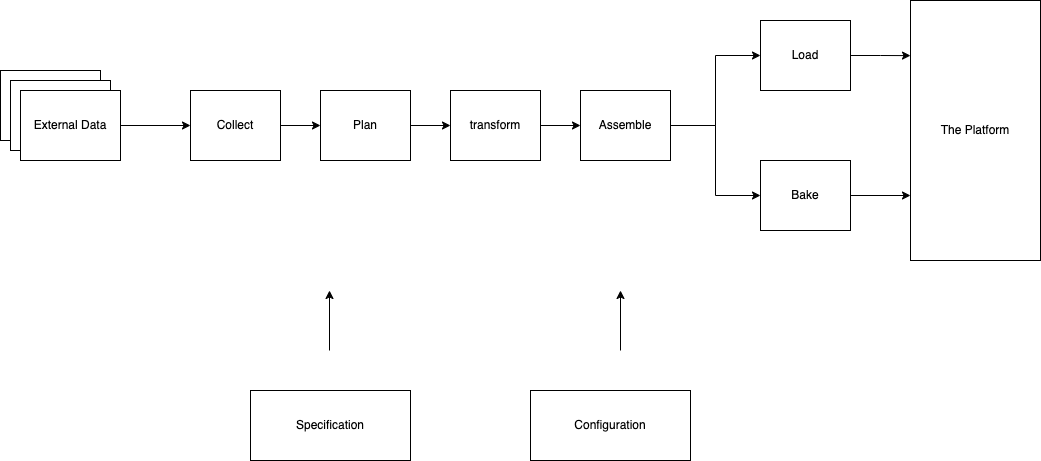
The collections workflow is how data gets onto the platform. It downloads data from external endpoints, transforms it against our specification and configuration, and publishes it in the formats consumers use.
There is one workflow per collection, and a collection contains one or more datasets. The DAGs are generated from the specification rather than hand written, so adding a collection to the specification is what creates its workflow.
These pipelines do not have their own unique code. They all run the same processes, and it is the specification and configuration inputs that produce different behaviour for each collection.
When it runs
The collection DAGs themselves are schedule=None — they do not run on their own. They are triggered by trigger-collection-dags-scheduled, a “DAG of DAGs” which runs nightly and starts everything in the right order:
organisation-collection, thenorganisation-builder— most collections need organisation data, so this goes first- every collection DAG, in a weighted order so the long running collections start early
build-digital-land-builder
trigger-collection-dags-manual runs the same sequence on demand. Individual collection DAGs can also be triggered by hand during the day.
The schedule, and which collections run in a given environment, come from the config.json that ships with the deployed DAGs, so they differ between development, staging and production.
The steps
Each collection DAG is built from these tasks. Where a collection has more than one dataset, the tasks after collect are created once per dataset.
| Task | Runs on | What it does |
|---|---|---|
configure-dag |
Airflow | Resolves environment configuration — CPU, memory, VPC and logging settings — and passes it to the tasks below |
{collection}-collect |
ECS Fargate | Runs bin/collect.sh: the collect process, then the plan process (make collection), then saves logs, resources and the collection database to S3 |
{dataset}-get-transform-batch-configs |
Airflow | Splits the resources that need transforming into batches, so transform can run in parallel |
{dataset}-transform |
ECS Fargate | One dynamically mapped task per batch, each running the transform process |
{dataset}-assemble-and-bake |
ECS Fargate | Runs bin/assemble.sh to aggregate the transformed files into a dataset and bake the published formats |
{dataset}-postgres-loader |
ECS Fargate | Loads the dataset into the platform database |
{dataset}-tiles-builder |
ECS Fargate | Builds vector tiles, for datasets that have geometry |
Note that plan does not have its own task — it runs inside the collect task, immediately after collecting.
Where the data goes
The layers below are the ones described in the data pipeline architecture overview, and correspond to the bronze, silver and gold layers of a medallion architecture.
| Layer | What is stored | Where |
|---|---|---|
| External sources | Nothing — this is the publisher’s endpoint | The open internet |
| Raw (bronze) | Collected resources and collection logs, exactly as downloaded | s3://{env}-collection-data/{collection}/ |
| Cleaned and transformed (silver) | Transformed files, issue logs, and the assembled dataset | s3://{env}-collection-data/ |
| Consumer (gold) | The published dataset, the platform database and vector tiles | S3, PostGIS, EFS for datasette |
Because raw resources and logs are kept, we can always describe where a value came from and rebuild what came after it.
Tools and services
- Airflow (AWS MWAA) orchestrates the workflow
- ECS Fargate runs each task as a container, using the collection-task image
- S3 holds every input and output
- PostGIS serves the data to planning.data.gov.uk
- EFS holds the sqlite files that datasette serves
The newer EMR based pipeline
title-boundary is too large to assemble on a single machine, so it runs through new-title-boundary-collection instead. It collects and transforms in the same way, but assemble runs as a PySpark job on EMR Serverless using pyspark-jobs, writing Delta tables to s3://{env}-parquet-datasets/.
Which collections use this route is controlled by NEW_COLLECTION_DAG_COLLECTIONS in dags/dag_triggers.py. Everything else uses the standard pipeline described above.
Repositories
| Repository | Part it plays |
|---|---|
| airflow-dags | Generates and schedules the DAGs |
| collection-task | The container that runs collect, transform and assemble |
| digital-land-python | The implementation of every process |
| digital-land-postgres | Loads datasets into the platform database |
| tiles-builder | Builds vector tiles from a dataset |
| digital-land-efs-sync | Puts sqlite files where datasette can read them |
| pyspark-jobs | The EMR Serverless jobs used by the newer pipeline |